I could never have imagined that I would write an epitaph for Ross Mitchell Anyon. Yes, we all heard about his calamitous accident, some seven years ago, when a fall from a ladder, while fixing an electrical installation in a high ceiling robbed him of the ability to make more splendid pots. While there was, for a while, fear for his survival he recovered sufficiently to have optimistic reports around his condition in circulation to the clay community and we rather hoped to one day see him partially, or largely, back to his old self. So it was with surprise and distress that we learned of his sudden death. Even more so as it was the eve of his departure for Wellington to receive his investiture as Officer of the New Zealand Order of Merit granted in the latest New Year’s Honours List.
But, to begin at the beginning, Ross was born in Australia, one of seven children of a father who seemingly could not settle anywhere for long and took his family between NZ and Australia several times. However, Ross became acquainted with clay while at school in New Zealand, in the times when many schools had ceramic facilities, and again as a student at Palmerston North Training College while he was a trainee teacher and the main instructor was Stan Jenkins. Ross graduated in 1975 but by then he had a case of the clay bug and by 1980 was a full-time maker of functional ceramics. Towards this he dug and processed his own clay, built a wood-fired kiln and developed a style of his own with a grounding in the Anglo-0riental traditions as translated by Stan Jenkins, and an overlay of Michael Cardew – whose celebrations of traditional English country pots were bold and straightforward. Ross added a huge slice of his own temperament – relaxed and casual with a dislike of any fuss or elaboration and his pots remained firmly utilitarian. He wanted them used for cooking, containing or serving food, preferably around a table with a gathering of friends and some good conversation.
Mug, jug and dinner plate. Undated.
Never designed to outshine the food, his pots nevertheless held their own with their evident fingering, generous rims, an occasional tooled furrow and small, insouciant but highly personal addenda that did clever things such as holding a base clear of the bench, or stopping a lid from falling out while pouring.
Teapots. Undated
His work was unfussed and finished with a simple tool for concentric grooves, a grab of clay in a squeeze of his fingers or a twist or fold of the coil. Knobs were generally the minimum required to lift a lid, sans flourish, and lugs or handles cleanly applied, rather than gesturally swiped into place. Surface was what the kiln and the salt did until much later when he dropped temperatures and switched to an oxidising firing as he decided that reduction with wood and salt were simply hard work he no longer wanted. Then slips, simple glazes and his fingers served.
Medium and small casseroles. and two soup bowls. Undated.
His fierce intelligence took no prisoners if the mood was inclement but at the same time he could be most generous if he sensed a parallel respect for his medium and mentees came and went, attracted by his work and his honesty and he did what he could to help their progress.
Large Casserole. undated.
Alongside his making in clay was his building, in stages, of his own home at the river’s side and a deepening concern for the destruction of Whanganui buildings that lay in the way of developers’ plans. He became a strong advocate for the preservation of these old structures and served as a Whanganui District Councillor so that there might be an opposing voice at official levels. He acted as well as speaking out and purchased buildings to prevent demolition, made them more habitable and sold them to artists at very reasonable prices so that the city he loved was enriched by a more diverse population.
Lid detail : stamp, knob and lug.
In December 2021 he was made an Officer of the New Zealand Order of Merit for his services to the arts and conservation – a recognition that gave him great pleasure. He was very shortly to travel to Wellington for his formal investiture when he collapsed at home and was found dead shortly afterwards. While he had made no pots in the years since his fall the work lies in treasured collections, private – where they will be in pleasurable daily use as he would wish and institutional, particularly with The Sarjeant, plus his legacy of many beautiful, preserved, lived in and loved old buildings will keep his memory alive. Our kindest thoughts and sympathy must extend to his family, both immediate and to the wider friends and colleagues.
Born in Luton, near London, one of Ann’s earliest memories, I remember her telling me, was crouching in a cupboard under the stairs at about age 6, when bombs were being dropped not far from her house, and she and her twin sister clung together in their hiding place. She also remembered modelling the warm wax from candles that illuminated the bomb shelter in the family backyard while warplanes rumbled overhead.
Her family was supportive of her love of drawing and making things with her hands and her father took her for an interview at St Martin’s School of Art in London when she was just 14. There she was told to return when she was 16 and with a ‘pass’ from the local Luton Art School but instead, because of her talent, she was allowed to attend school just one day a week (but had to also pass the standard exams) and spend the other four days at the local Art School where she studied life drawing, anatomy, art history, architecture, painting, sculpture, clay modelling, plaster casting and wood carving plus illustration using a range of media, bookbinding, costume and weaving. Following this solid foundation, she went to Hornsea School of Art (later Middlesex University) where she took sculpture and ceramics as her majors. As she wrote, “being an art student in London in the 1950s was exciting. The Tate Gallery, the V&A, the British Museum and National Galleries had their collections on display, out of safe storage after the war… there were inspiring exhibitions and displays … Jackson Pollock, Henry Moore, Matisse…”. After graduation in 1955 she applied to Royal College where she was offered, not the sculpture course desired but ceramics, however, not wishing to learn slip casting or spend a year at Stoke on Trent in the ceramic factories there, because the course then, had a strong commercial base, she declined. Returning home to Luton, Ann found varied and interesting work with commissions, followed, in 1958, by teaching at her old art school where she met John Lawrence who was then Head of Department. They married in 1959.
In January 1965 they, with their two young children emigrated to New Zealand. John was to be art teacher at Tararua College in Pahiatua. Their understanding was that Pahiatua was a university town but found John’s classroom was actually a prefab in the middle of a field and John was required to also teach Mathematics and Social Studies. This must have been, to say the least, distressing and I remember Ann telling me about how she found the contrast with a lively post-war London, ‘grim’. But they had brought kilns and a wheel and the interest here, in functional ware, was considerable as it was the era of Government restrictions on what might be imported to compete with domestic production from Crown Lynn and a few smaller manufacturers. This policy meant there was wide public engagement with the hand-made wares of small pottery enterprises. Retailers in New Zealand were delighted to find another source of well-made pots and this extra income was supplemented by Ann’s teaching clay at training college and at the evening classes which were so avidly attended all across the country in those times, thanks to the Tovey ‘arts access for all’ policies. John and Ann moved to Dannevirke in 1970 and domestic life filled her days alongside her two children while occasionally exhibiting in group shows.
Her opportunity to expand beyond this came with Luit Beiringa, and Margaret Taylor of the Manawatu Art Gallery. She was invited to participate in a 1980 exhibition that was being drawn together, to later tour to the Sarjeant in Whanganui, called ‘Still Life is Still Alive’. Her modelling abilities had been noted and she was asked to provide a number of vessels in the style of Morandi so that members of the public and students could draw and paint from them within the gallery space. Familiarity with Morandi’s visual vocabulary had been hers since London in the 1950s where his work could be viewed at the Tate and the Courtauld galleries. This reacquaintance with and working from those paintings was to set her path for much of the remainder of her career.
Initially it was a solo show at The Dowse, when it was steered by James Mack, called, ‘Still Life’, that encouraged her to explore further some of the ideas she traversed in working for the earlier exhibition. Over the course of the following almost forty years she mined her upbringing in post-war Britain and particularly those seven years studying the arts in two excellent colleges and the multitude of collections in galleries and museums. Those memories plus her scrutiny of the armloads of books on art, mostly 20thC., with which she returned from the Dannevirke Library, having ordered them from the rural library service, were fundamental to her ongoing engagement with painting, rather than sculpture, as primary source. These elements were underpinned by her fecund imagination and subversive humour applied with intelligence, restraint and an ongoing pleasure in what possibilities can lie with clay. She delighted in turning an image into three dimensions and while originally she stayed within the framework indicated by the painting it was not long before she used those abundant abilities to “see what else was there”.
Not quite Magritte. 1985. Private colln.
Who could forget works like the dishes of bananas where the patterns on a decaying skin steadily transferred to the dish, enclosing a pair of naked fruit. Or, the nest with eggs tucked inside the back of Magritte’s ‘Man in a Bowler Hat‘s hat. As she continued, more complex questions occurred and the ‘unknown views’ were sought more vigorously. ‘The Velasquez Girls’ mixed historical styles of dress and of rendering with aids – a wheeled trolly! – to allow movement in such cumbersome clothing as well as ideas about what might be hiding behind those vast panniers and towering hairstyles. The mixing of influences can also be seen in clothing from one painter’s subject adorning another subject: Matisse’s Romanian blouse clothes a model for Modigliani.
A group from ‘The Velasquez Girls’ 1980s Colln. The Dowse.
Increasing complexity is evident when she leaves European sources and tackles McCahon’s painting, ‘The Promised Land‘ with her version of its structure but very different meaning. For Verdcourt this painting was about washing the family dishes as those stacked bowls were the foreground hillsides and the towering angel figure is tied to the house while it is Ann herself, only in a farmer’s black singlet, that is contemplating the jug, cups and dishes that remain on the draining board. But there is no question that she might suffer defeat. Her gaze is resolutely confident.
‘Trying to enter the promised land.’ 1992. Colln. The Dowse.
Other departures prospect her sensitive searching for her version of anatomical truth and perhaps finding something other eyes had passed by. ‘Ceremonial Elbow‘, she wrote me, was “in honour of the naked Nubian body” a programme we had both viewed on TV where the lithe, angular, elongated figures were clothed only in clay slips – white with black spots – and the movement lissom as they strode an arid land.
And in, “I’ve only met Richard at parties‘, she makes a grouping of versions of one man’s head – someone she knew very little but found his head worthy of photographing from a number of angles, and modelled seven versions, each subtly and intriguingly different, then assembled them into a formation so that, while kept largely monochromatic, their differences in expression and projection could be considered.
‘I’ve only met Richard at parties’ 1990. Private colln.
And so it went. Many groups and series, all contemplated for long periods, from every angle, for weeks or months before anyone else might view them, adjustments and changes made as seen necessary until the work satisfied her. Clay was her preferred medium – she was never tempted by bronze casting – as she knew that clay could offer her every possible surface and colour. Its use meant her fingers, perhaps the very cleverest in the country, were constantly engaged, responding to what her eyes observed and her astutely whimsical intelligence imagined. Another medium would mean she must pass some parts of the process to others, which did not interest her – she simply loved to make. Her absence will leave a gap that no one can fill, not only for her beloved John and their family but for us all. She was uniquely a one-off.
John and Ann – Just married.Ann contemplating a pear.
‘Only in America’ could be said about this collaboration between a chef (who is also a potter) and a ceramist. Many these days work with restaurants making obviously hand-made ware , unique pieces and small runs, for their food. Sometimes I have wondered, as food was placed before me by some black-apron-ed wait-person, how such a vehicle would survive the sort of treatment that can be dealt to dinner ware in the back rooms and kitchens of these establishments (having done my wait-personage turn back in student days). Other times there was cause to celebrate as just the right size, colour and surface of a piece of ceramic discretely shone beneath some consequence of a chef’s imagination. Here, for your digestion is what could well be described as the ultimate collaboration as there is little that is discrete about this dinnerware – it demands its place at table alongside the food.
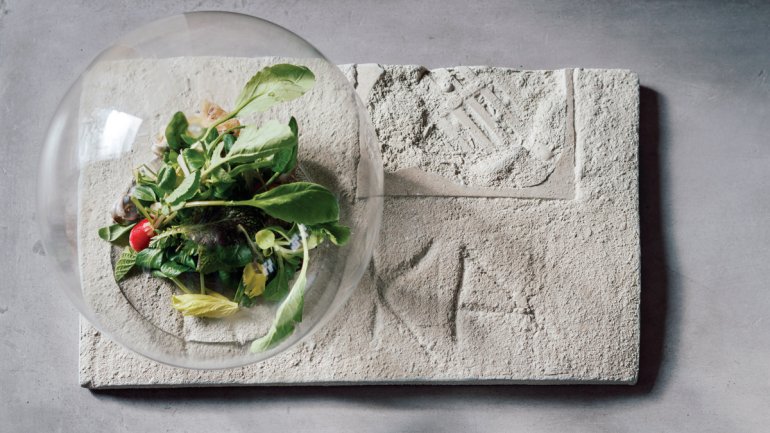
Black Lung: A Terrarium for Black Breath includes salad leaves and chicken-fried mushrooms. It’s served inside a glass sphere on a ceramic plate that’s a reproduction of the West Philadelphia sidewalk. Photo by Elena Wolfe.
As a chef and artist, Omar Tate is laser-focused about what he puts on a plate, but he rarely gets the opportunity to think about the plate itself. That changed when Tate joined the chef-in-residence program at Stone Barns Center for Food and Agriculture in New York and learned he’d be able to collaborate with a ceramist on his tableware.
“Plateware has always been important to me, but I could never really afford to buy plates that are specific to the dishes I make,” says Tate, who runs a recurring pop-up dinner series called Honeysuckle in places like New York, Philadelphia, and Martha’s Vineyard and was named Esquire’s Chef of the Year in 2020. “All I could really control from my end were the food and presentation.”
To showcase his multicourse meal, which reflects the Black American experience, Tate met with artist, designer, and ceramist Gregg Moore and quickly realized their relationship would last well beyond the residency. “Meeting Gregg opened up a whole world of possibility for me in the form of what ceramics can be and how it can help create an immersive 360 experience,” says Tate. “Gregg isn’t just some dude who make plates—he’s not Crate and Barrel, you know?”
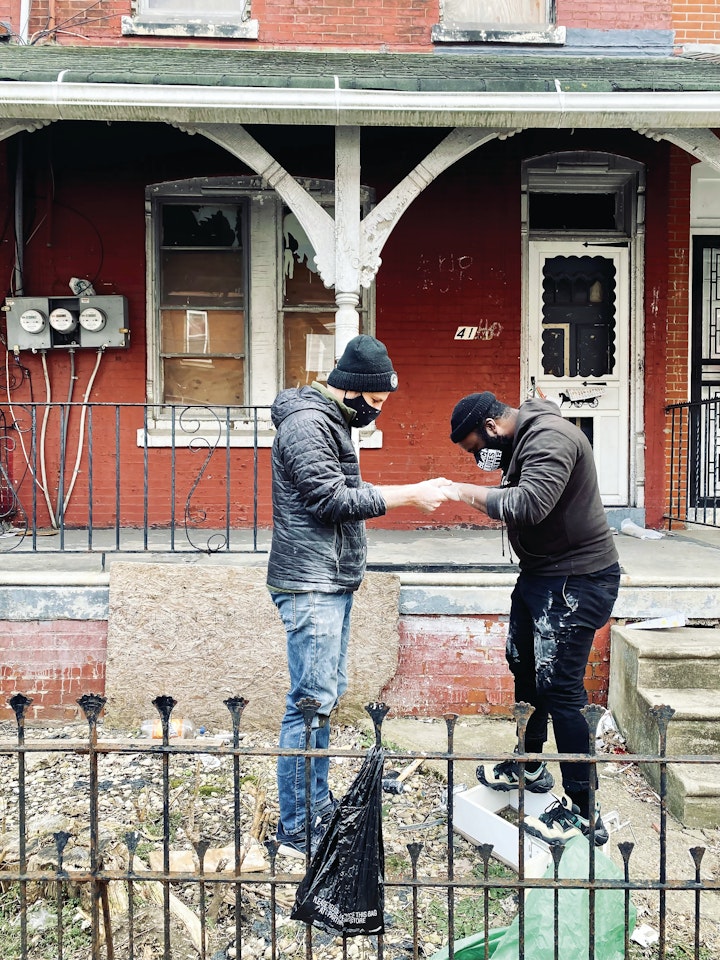
For his first course, Tate served a dish called Black Lung: A Terrarium for Black Breath, an ode to Black lives lost in conflict in 2020. Bright green salad leaves and chicken-fried mushrooms are served inside a delicate glass sphere on what looks like a slab of asphalt. In reality, it’s a porcelain plate Moore made based on the sidewalk in front of Tate’s mother’s house in West Philadelphia. Tate and Moore together made a plaster cast of the actual sidewalk—with a drainpipe cover, moss, and the name POOKA carved into it—which Moore used as the model for the plate.
Gregg Moore and Omar Tate make a plaster cast of a section of sidewalk in front of Tate’s mother’s home in West Philadelphia. Photo courtesy of Blue Hill at Stone Barns.
“2020 was a difficult year for us all, and the palpability of Black death made it even more treacherous,” Tate explains. “The cast of concrete, a drainpipe cover, moss, and etching of the name POOKA was chosen to examine the tension between black bodies, concrete, and nature in cities and ghettos.”
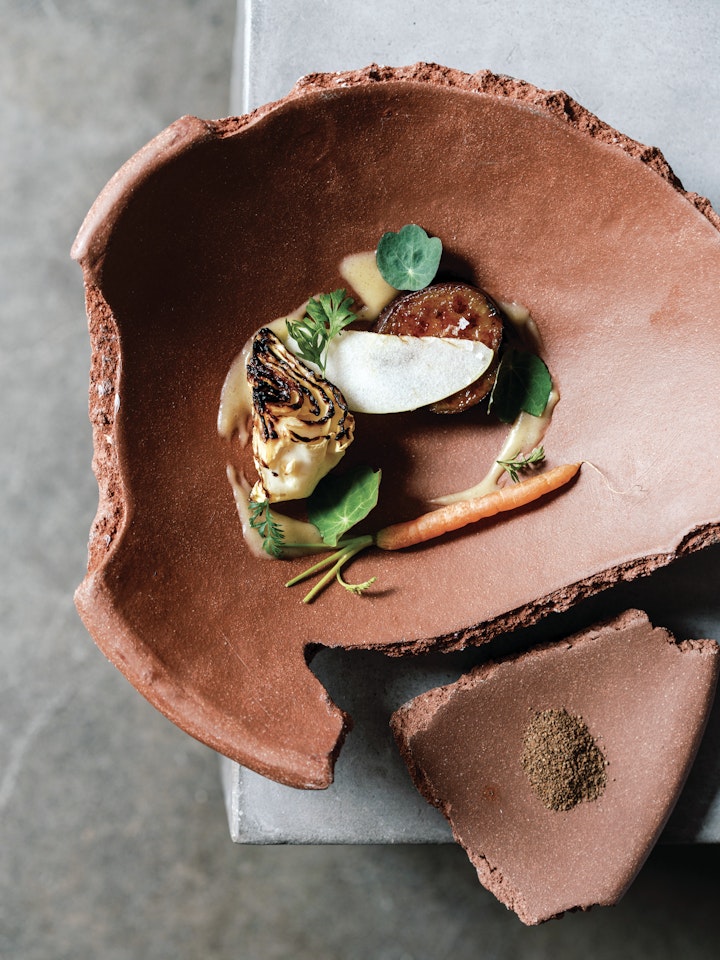
Another course that Tate conceived, called Notes on a Black Pantry, was served in dishes inspired by colonoware, a type of earthenware pottery made and used by enslaved people during the colonial period. An intact colonoware dish has never been found, says Tate, so Moore purposely created shards of pottery that Tate used to serve his course in fragments at the table. The various pieces of pottery featured confit ham, smoked plantain puree, carrots poached in carrot juice, and what Tate called Cabin Spice, a blend of spices, including clove, nutmeg, allspice, cardamom, and black pepper, that could be used as a condiment.
Colonoware is an unglazed earthenware made and used by enslaved people in colonial times. Omar Tate and Gregg Moore’s design for these ceramic fragments was informed by the fact that no piece of colonoware has ever been found intact. Photo by Elena Wolfe.
“I wanted to represent the spice trade, which was one of the largest perpetuators of the transatlantic slave trade,” says Tate. “The irony is that folks were brought here because of spices and then were not allowed to use those spices. If they did, they would have to use it in secret” in their cabins.
Omar Tate is one of many chefs who’ve collaborated with Gregg Moore this year at Stone Barns Center, which houses Blue Hill at Stone Barns, the pioneering farm-to-table restaurant helmed by chef Dan Barber. Last summer, though, Stone Barns Center announced it was creating its Chef in Residence program and that the restaurant kitchen would be turned over to a series of visiting chefs as a way to strengthen and expand its community—and to tackle racial and gender inequities in the restaurant industry.
“It’s not just a back and forth—it’s a back and forth and a back and forth and a back and forth.” —Gregg Moore
“Blue Hill and the Stone Barns Center together are very much this synergistic community of cooks, farmers, scientists, producers, artists, and others. We started the Chef in Residence program to extend this community outward, knowing that we need fresh voices and diverse perspectives to create an eating culture that supports and encourages the right kind of farming,” says Barber. “Each resident chef initiates a reimagined community through intimate collaborations with our bakery, our butchery, and with artists like Gregg.”
BACK TO THE LAND
The chef-ceramist collaborations that have taken place this year through the Arts & Ecology Lab at Stone Barns Center are not Moore’s first. Before working with Tate, Victoria Blamey, Shola Olunloyo, and Johnny Ortiz, Moore teamed up with Barber. Back in 2014, Moore read The Third Plate: Field Notes on the Future of Food—Barber’s seminal book about food, farming, and sustainability—and was struck by the synergies between Barber’s process and his own.
“There are so many connections between my practice in the studio and Dan’s process in the kitchen. There was hardly a page in the book that wasn’t dog-eared or had Post-its stuck to the page,” says Moore. At the most elemental level, Moore says, both he and Barber use heat as a transformative ingredient: “It takes materials and turns them into objects on my end, and it takes ingredients and turns them into food on Dan’s end.”
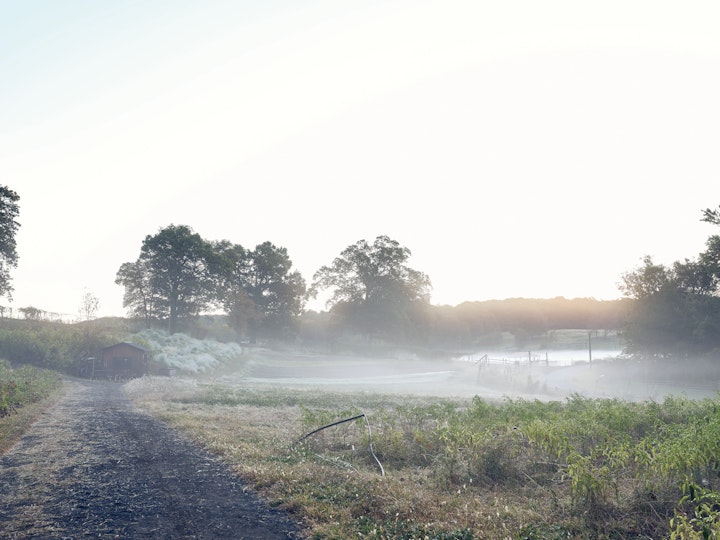
The landscape at Blue Hill at Stone Barns in upstate New York. Photo by Alice Gao.
“Gregg visits the farm, spending time with the animals, walking through the fields, immersing himself with the same voracity that I do as a cook.” —Dan Barber
Moore, who is a professor at Arcadia University and studies the intersection of agriculture, ceramics, and cooking, reached out to Barber with an idea: Why stop at food when it comes to the farm-to-table ethos? Why not craft dishware that also draws on the materiality of the farm landscape? Barber was instantly sold.
“Gregg made me realize that we were thinking about the food—the way it’s grown and raised and everything that goes into the creation of a plate—but ignoring the plate itself,” Barber says. “I was ignoring the raw material of our plates while obsessing over the raw materials of our food.”
Since 2015, Moore and Barber have collaborated on a number of dishes, starting with the foundational Chef’s Plate, a black porcelain plate with a stonelike appearance. “It was a new challenge for me because I hadn’t made pottery for restaurants—ever,” says Moore. Not only did it have to be very durable, he explained, but, most importantly, it could not upstage the food.
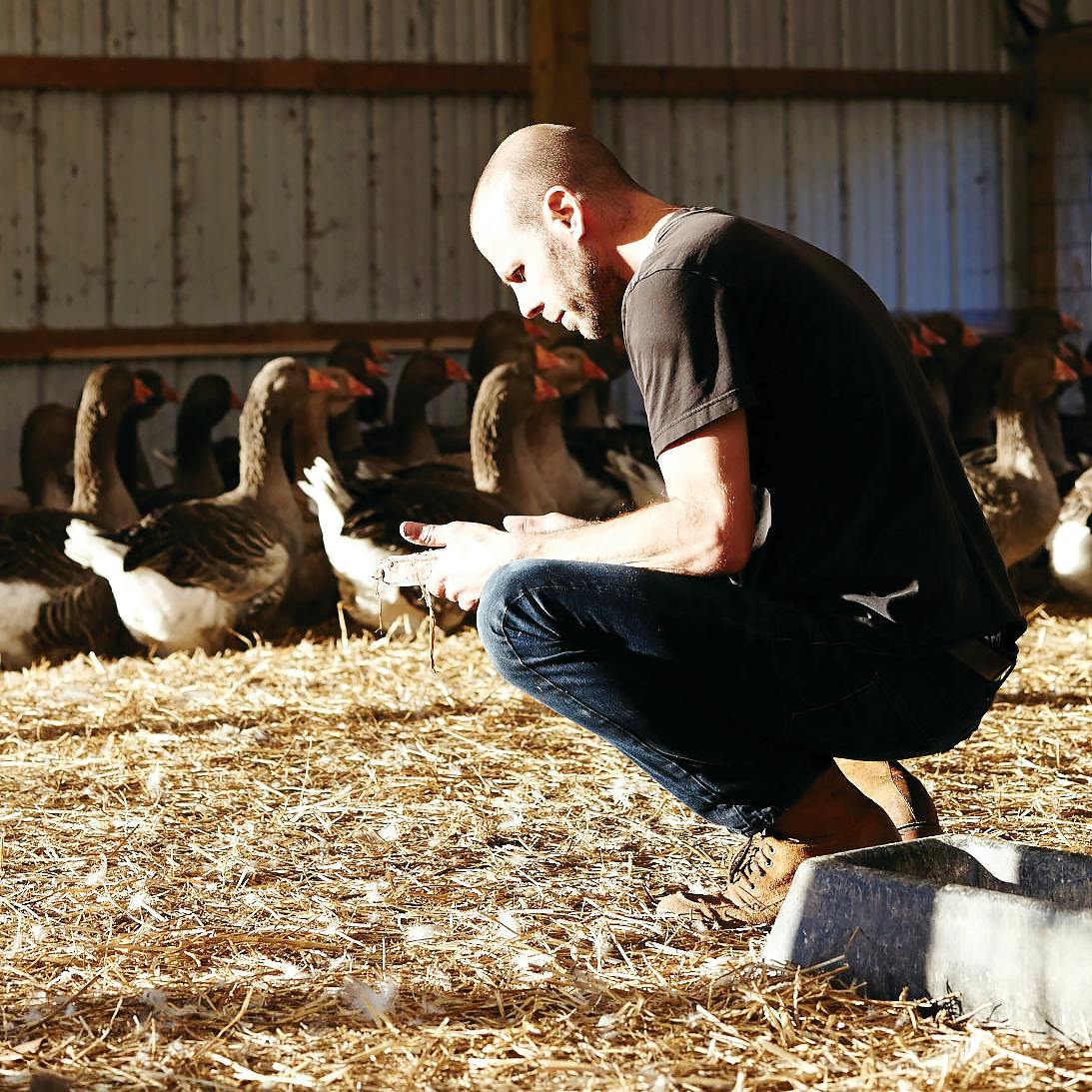
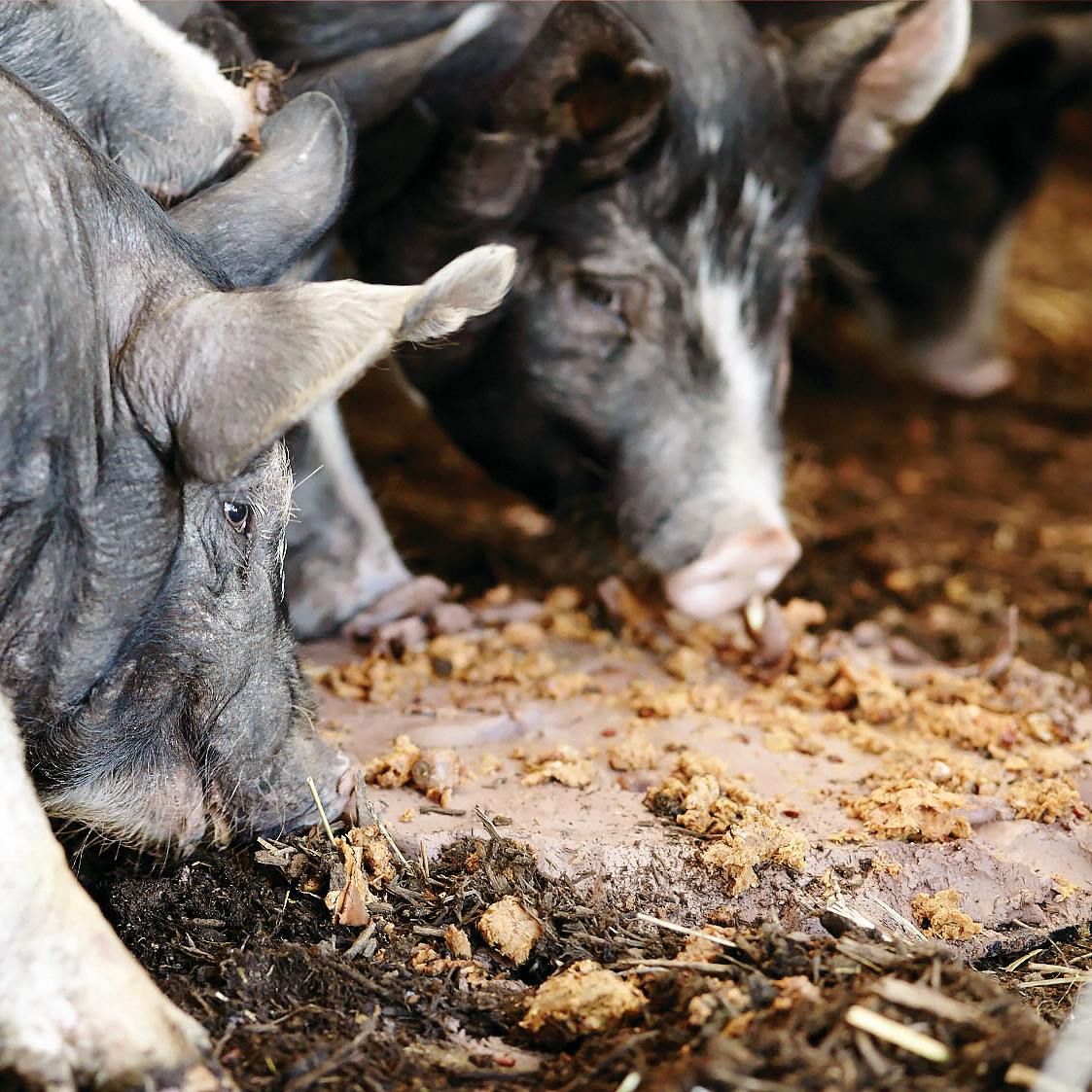
Moore and Barber’s ceramic collaborations range in tone from whimsical to jaw-dropping, but they’re always inspired by the farm at Stone Barns Center. For example, a trio of plates called Grazing, Pecking, and Rooting were all made with the assistance of various Stone Barns animals.
LEFT: Moore with Toulouse geese. Photo by Jochem Van Grunsven. RIGHT: Impressions left by the geese appear on the Pecking Plate. Photo by Andrew Scrivani.
For the Grazing plate, Moore actually grew grass in a raw clay plate so that Stone Barns sheep could eat off of it. He then used the plate, which was marked by impressions from the grazing sheep, as a mold to make a ceramic version. Barber used the final black porcelain plate to serve a dish of sheep’s cheese coated in biochar, with melon and carbonized sheep bones. The Pecking plate, a black porcelain plate with surface texture formed by geese eating feed, was used to serve two fried chicken’s feet. When Moore made the Rooting plate, the Berkshire pigs that ate off the clay plate were so gung-ho they destroyed it before Moore could bring it back to his studio. Barber used the final version, a black porcelain plate marked by pig-snout impressions, to serve a tiny tart filled with various foods pigs forage.
LEFT: Berkshire pigs leave their mark in clay that Moore later uses as a mold for Rooting Plates. Photo by Jochem Van Grunsven. RIGHT: Pig tart with foraged greens and sumac served on a Rooting Plate. Photo by Andrew Scrivani.
“One of the more exciting parts of this whole process for me is coming up with some admittedly strange things to call plates and seeing how Dan runs with it,” says Moore. “It takes looking through a different lens . . . to activate these with food.”
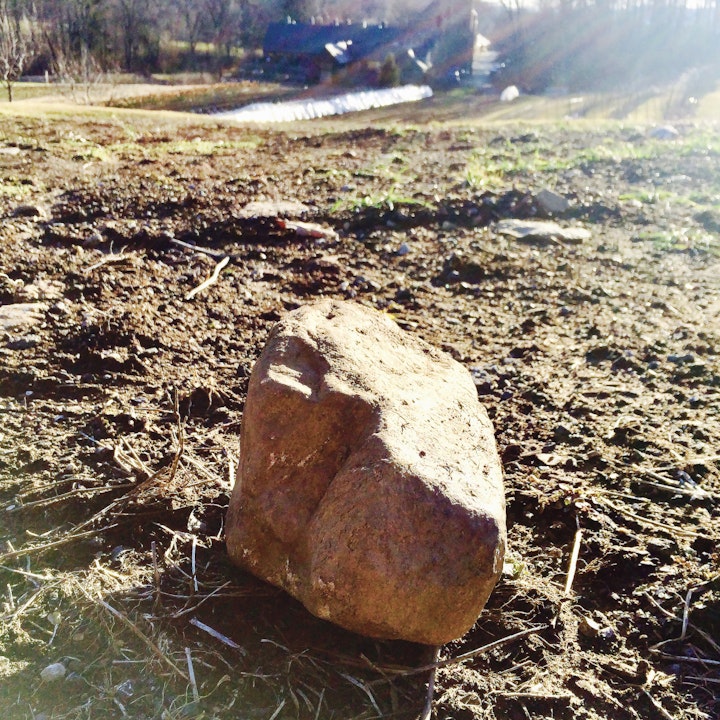
Another collaboration is the Single Stone Plate, a gorgeous stoneware plate glazed with a single fieldstone from the Stone Barns farm. It came about because Moore was looking for a “ceramic analog” to Barber’s famous “single-udder butter”—butter made from the milk of a specific cow. As he walked around Stone Barns, Moore noticed a large stone near the top of the vegetable farm. Moore has a background in geological science, so he was pretty sure that, if processed correctly, the stone would turn into a glaze. His hope was that plates glazed with a single stone would “speak to the locality of the geology of the farm in a way that the butter speaks to the biology of the cow,” he says.
Moore brought the stone back to his studio, fired it, crushed it with a sledgehammer into the texture of sand, and then used a machine called a ball mill to pulverize the sand into a liquid—the resultant glaze which he sprayed onto a plate and fired.
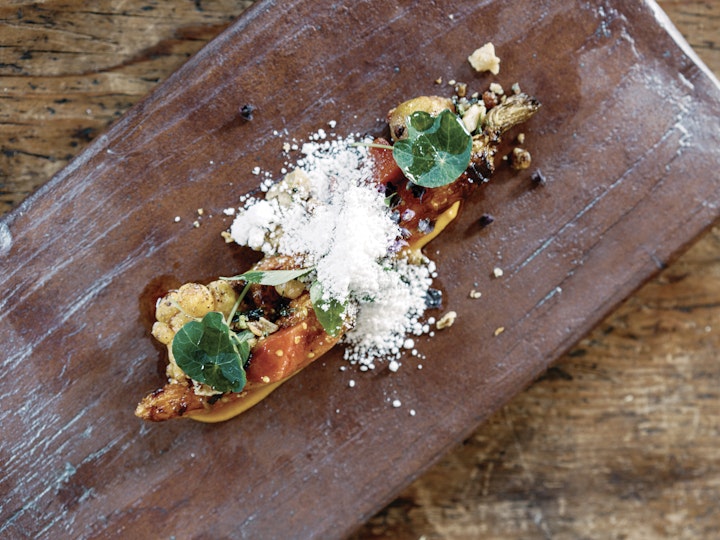
“I got about 100 plates out of the glaze and then it was gone,” Moore says. He had no idea how the richly plum-colored plate would be used, but Barber eventually served eggplant on it, cooked in a bright green turmeric leaf.
This Single Stone Plate is used to serve Chef Barber’s Choryoku eggplant cooked in turmeric leaf. The plate’s glaze was made from breaking a single fieldstone found on the farm with a sledgehammer. Plate photo by Andrew Scrivani. Fieldstone photos by Gregg Moore.
“What I really value in this relationship is that it’s not monodirectional,” Moore says. “I think the word collaboration gets misused way too often these days, and that people are probably more speaking of a commission than a collaboration. The Single Stone Plate is a good example of our deep collaboration—me coming up with an idea inspired by his idea of the butter and then giving it back to him to think about how to use it. It’s not just a back and forth—it’s a back and forth and a back and forth and a back and forth.”
Barber agrees: “The truth is, our collaboration is rooted in the same philosophy as the Blue Hill menu at large—it all starts with the farm. I don’t present Gregg a carrot dish and ask him to design around it, nor does he come to me with a certain aesthetic that I then cook towards. Gregg visits the farm, spending time with the animals, walking through the fields, immersing himself with the same voracity that I do as a cook.
“That’s the magic of Gregg’s work—it captures the textures, flavors, and visuals of the landscape inspiration before it does any individual dish.”
COLLABORATION, NOT CONTROL
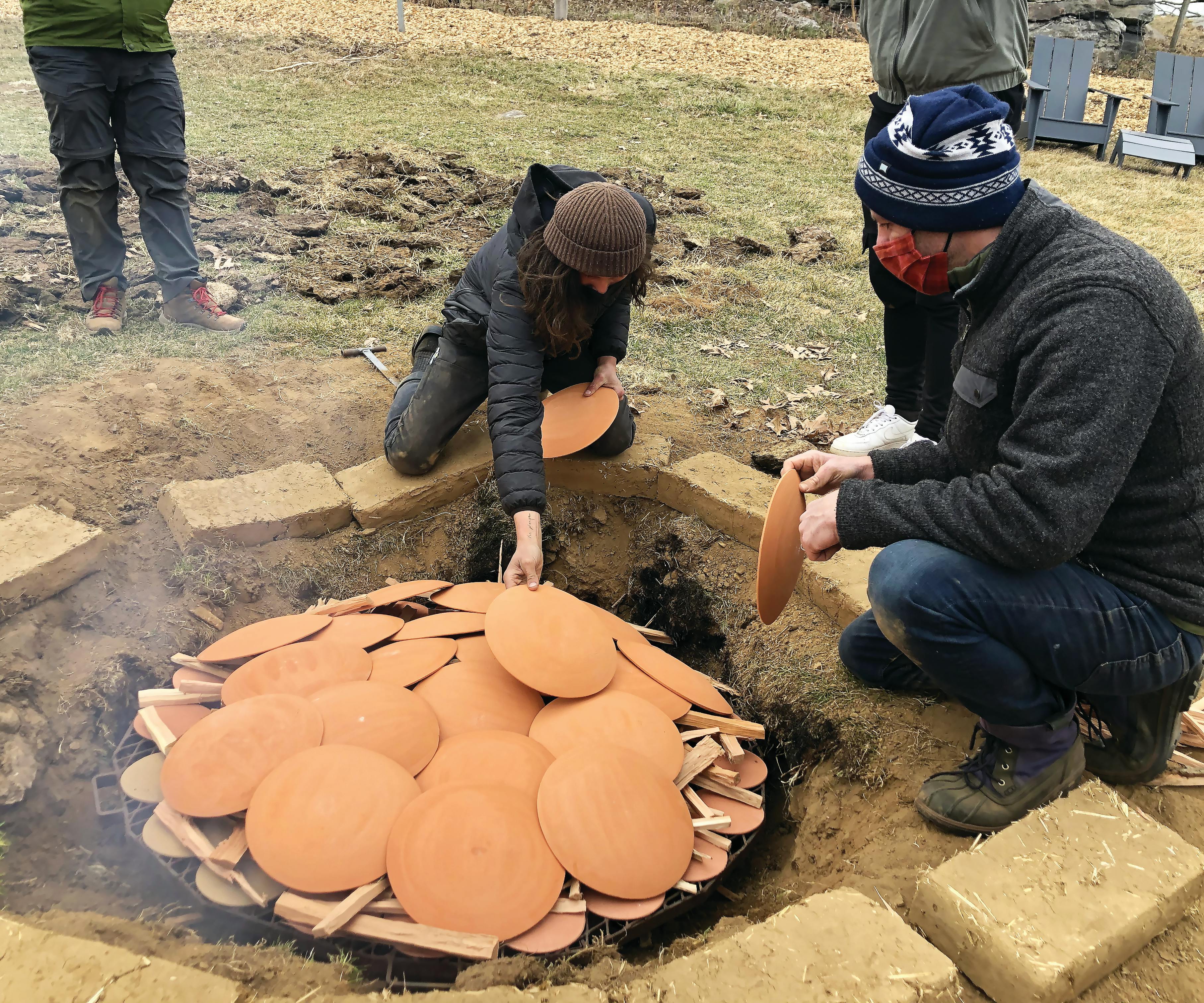
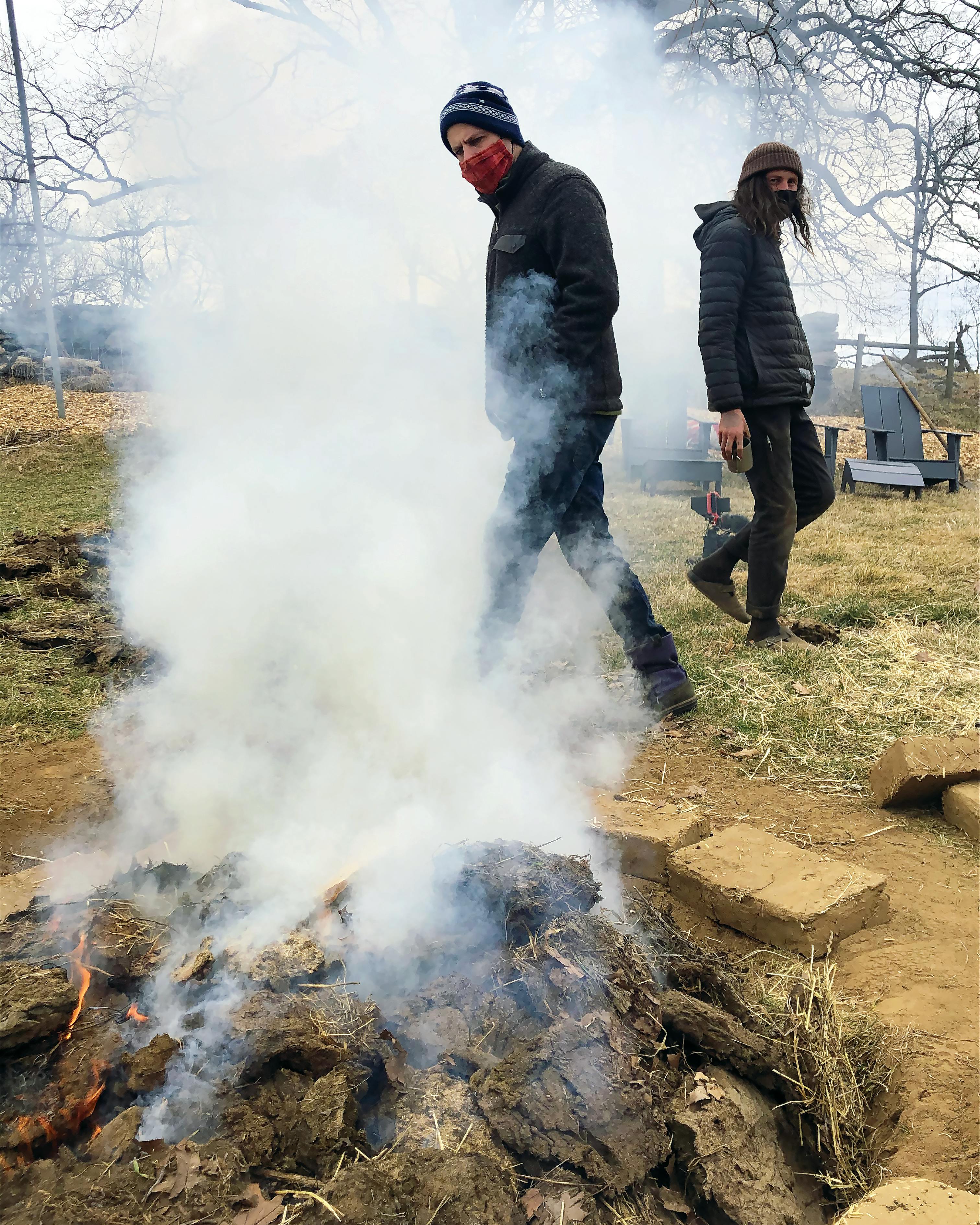
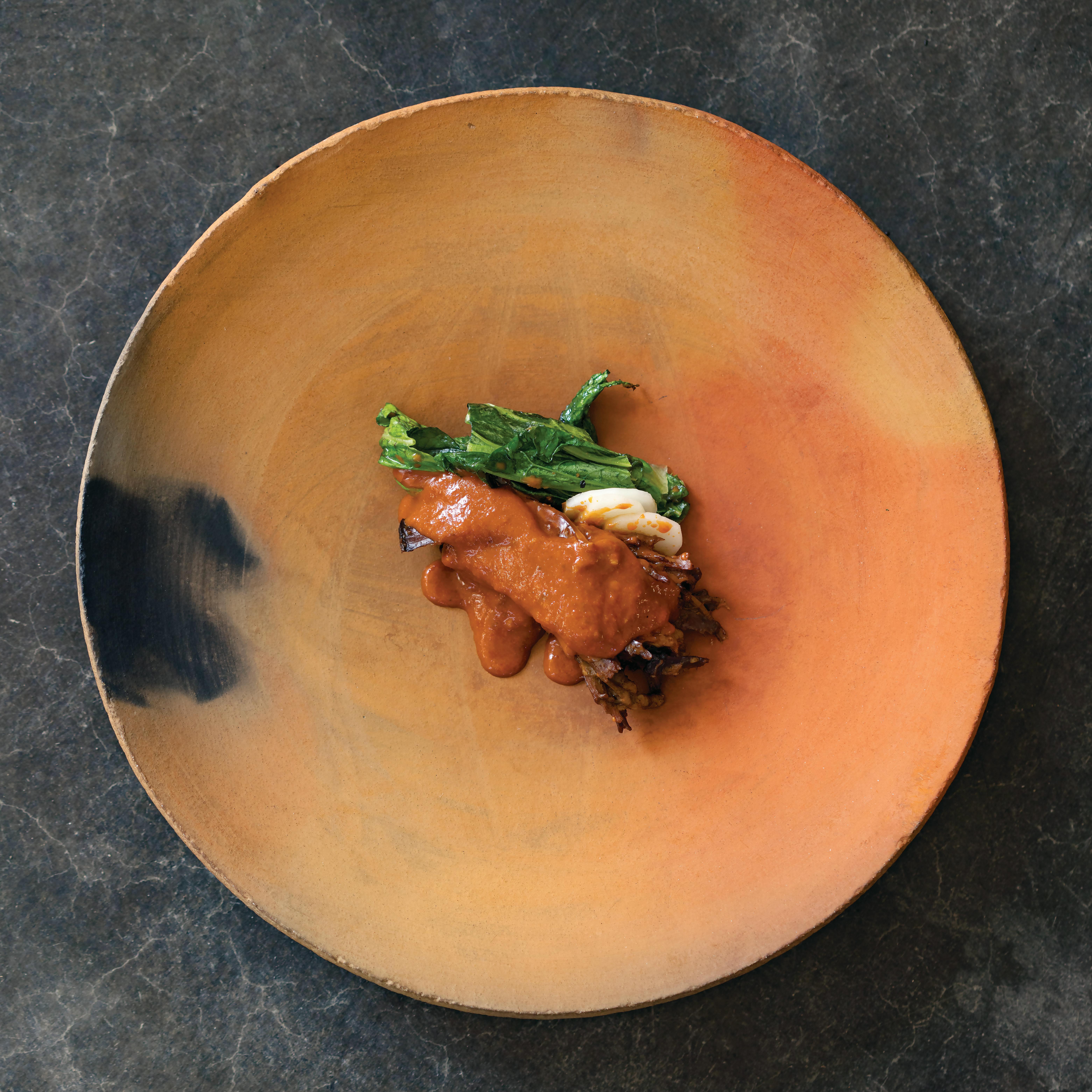
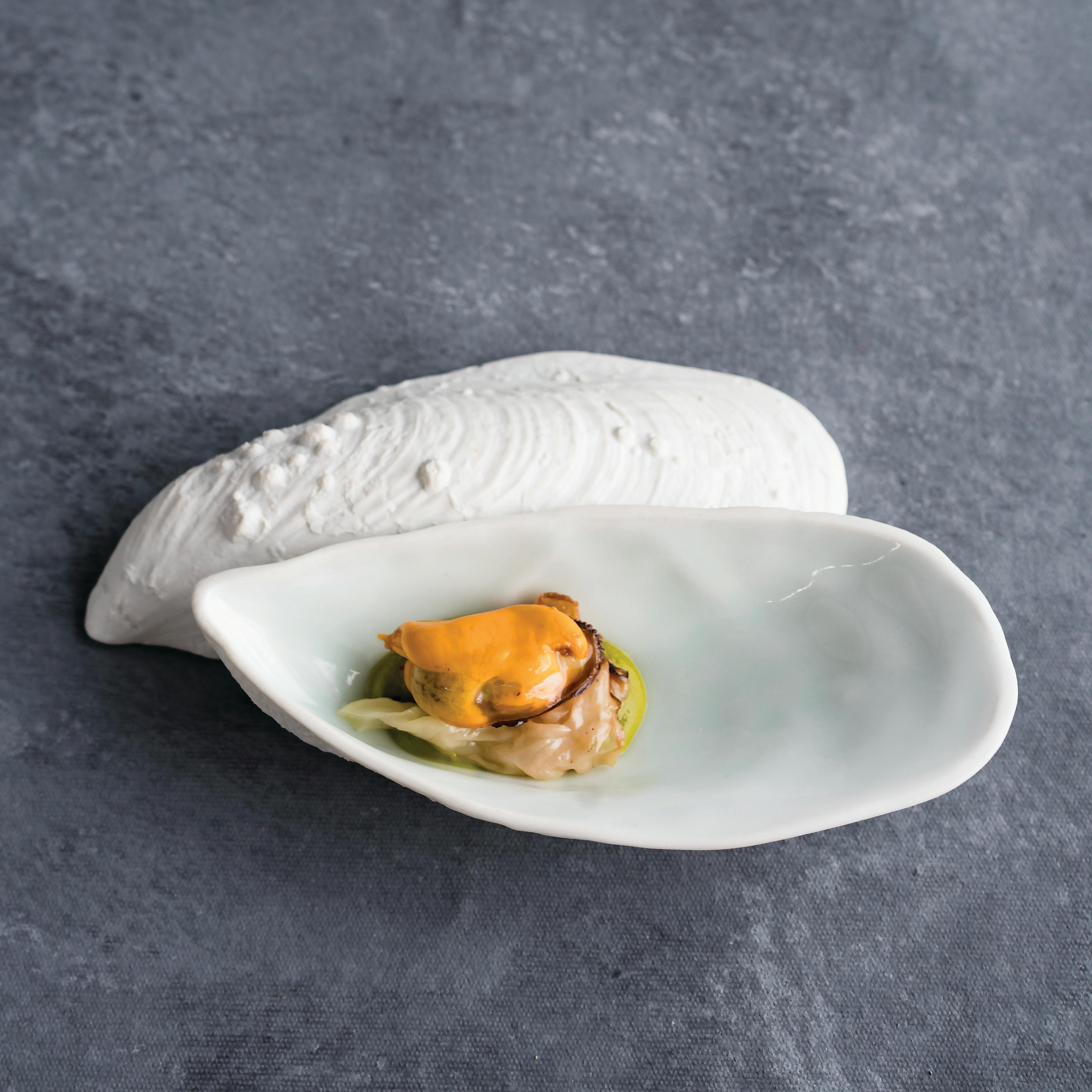
That was certainly the case when Moore collaborated with New Mexico chef Johnny Ortiz on earthenware plates that were coated with terra sigillata made from Stone Barns Center farm soil, pit-fired on the farm, and coated with grass-fed beef tallow. The landscape was also the main influence when Moore collaborated with Chilean chef Victoria Blamey on a series of ceramic dishes inspired by the Chilean coast: the glazed porcelain Coast Plate, the glazed stoneware Kelp Plate, and the porcelain Mussel Bowl with interior glaze.
TOP: Chef Johnny Ortiz and Moore firing plates at Stone Barns Center. The earthenware plates are coated with terra sigillata—a refined clay slip—made from farm soil, then pit-fired and cured with tallow from grass-fed beef cattle. Photos courtesy of Blue Hill at Stone Barns. ABOVE: Ortiz’s horno short rib with red chile and tsa tsai mustard greens served on one of the plates. Photo by Elena Wolfe.
Moore, who spent a semester in southern Chile 25 years ago, remembers cooking giant mussels on the beach and paddling through dark, oily kelp forests. “Working with Victoria was very meaningful for me because I have not been back to Chile since college,” Moore says. “The collaboration was like an invitation to travel back through Victoria’s cooking and through object-making for her residency.”
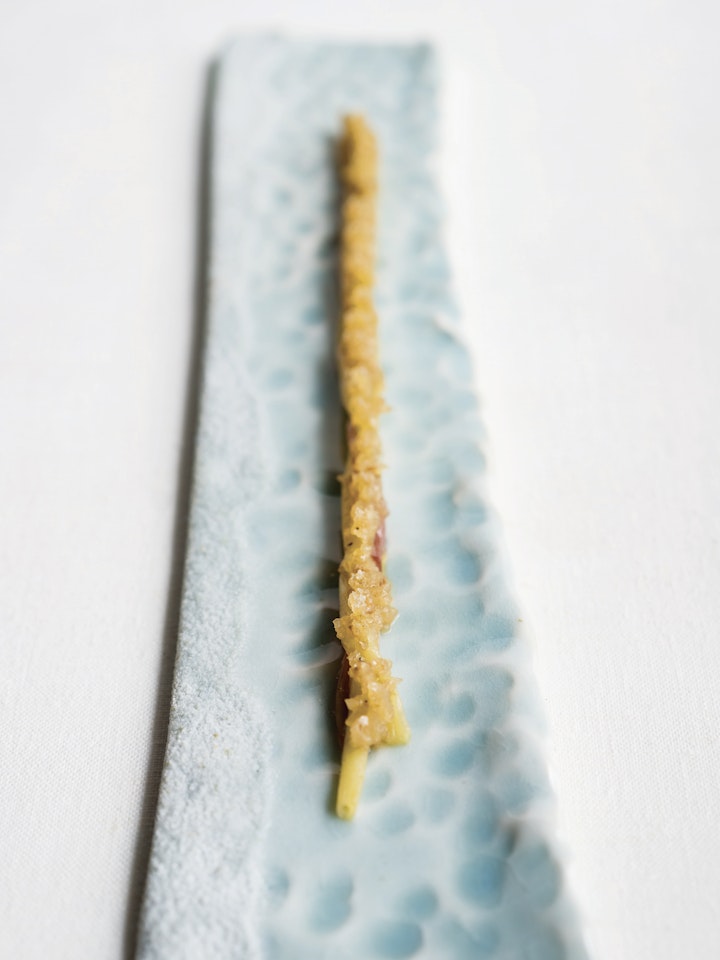
The sky-blue Coast Plate, inspired by the 4,000-mile-long Chilean coastline, is very long and narrow and has sand embedded along its length to represent the beach. At one point, Moore was concerned the plate was too narrow to be functional, so he called up Blamey and said he would make it wider.
“I said, ‘Just make the plate how you want to make it, and I will find a way to make sure I can plate something there,’” Blamey recalls. “This residency is also about showcasing what he’s doing. He’s an artist, and I’m an artist collaborating with him, so this collaboration has to meet in the middle, you know?”
This narrow porcelain Coast Plate—its glaze embedded with silica sand—is paired with a narrow dish: sugar kelp with a shiitake mushroom coating. Photo by Elena Wolfe
Blamey ultimately used the dish to serve sugar kelp stipe with rhubarb and turnip kraut. She had always wanted to do a dish with stipe—the long stalk of the seaweed plant—since she learned from Chilean seaweed farmers that there was only a market for the leaves of the plant. When she learned that she could get sugar kelp stipe from a Maine-based farm, she thought, I have the perfect plate for this.
“It was a very organic, natural process collaborating with Gregg,” Blamey says. “What I loved about collaborating with Gregg is that he is very feminine in his approach. It’s not just a rational, straightforward conversation—we talked about symbolism and creation and the origin behind the dishes I was working on. I think he has an incredible capacity to put himself into whatever it is that you are trying to express.”
This porcelain Mussel Bowl with interior glaze, a collaboration of Moore and Chilean chef Victoria Blamey, was used to serve cholgas secas, a mussel dish. Photo by Elena Wolfe.
Chef Shola Olunloyo agrees. “Working with Gregg was very symbiotic,” says Olunloyo, who makes modern Nigerian food. “We would have conversations about the culture of eating in Nigeria, both in public and in home, and he would literally translate my ideas into tactile objects within forty-eight hours. I’m like, ‘Dude, do you have, like, fifty elves making these things?’”
From Moore’s perspective, he actually embraces the loss of control that comes from collaborating with others. His work is not final when it leaves the studio, he says, because he gets to see how it will actually be used—or “activated,” as he puts it—by the chefs, servers, and diners at Stone Barns, and that can change his process.
Nigerian chef Shola Olunloyo’s roasted carrots, coconut, toasted nuts and grains, and oxalis sorrel on a plate made of iron-stained stoneware. Photo by Elena Wolfe.
“I get to watch Dan cook a lot and see him plate, and that informs a lot of what happens back in the studio,” Moore says. “Watching him use the plates that I’ve already made, I can learn about how to make the next plate better. I can make the most brilliant plate in the world, but if he doesn’t grab it to use it, it’s useless.”
HOLDING HEALTH IN YOUR HANDS
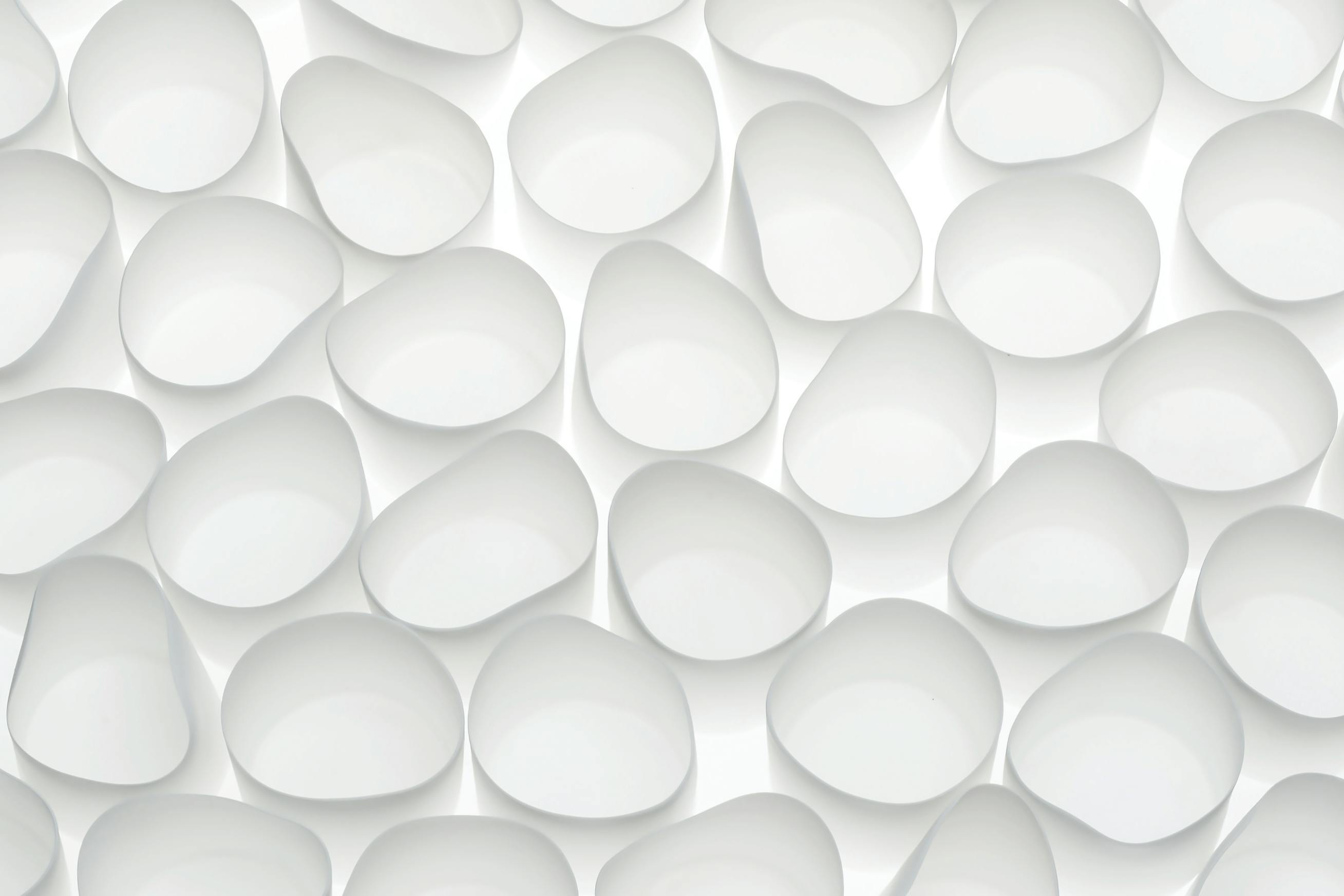
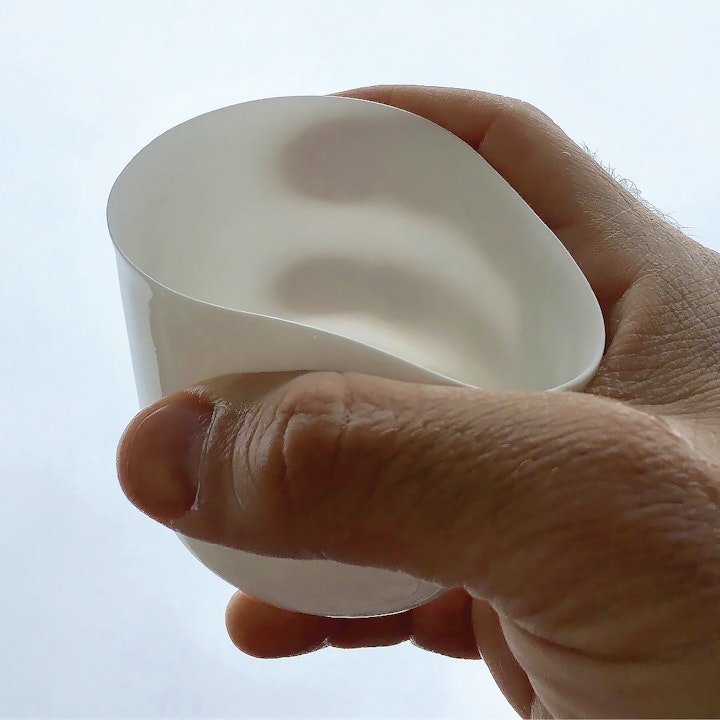
It was a conversation with Barber that led to their flagship collaboration—bone china made from the bones of Stone Barns grass-fed cows. After a late-night kitchen chat with Barber, Moore says, “I remember driving really fast home that night to see if I could make bone china out of these white bones.” The resulting plates, bowls, and cups are both astonishingly white and translucent and very strong. For comparison’s sake, Moore made a dish using bones from industrially raised, grain-fed cows and discovered that the resulting dishware was much more brittle and not nearly as white. Based on his discovery, Moore is working with an evolutionary biologist on a study of the effects of farming practices and animal husbandry on the material properties of bone china.
Moore discovered that these delicate bone china cups—made from the bones of grass-fed cows—are whiter and less brittle than those made from grain-fed animals. Photos courtesy of Gregg Moore.
“In essence, Gregg’s bone china is physical proof about the health and ecological qualities of good agriculture,” says Barber. “That diners can hold that in their hands is a powerful experience.”
Moore is currently overseeing more chef-artist collaborations and is planning to exhibit his collaborative ceramic pieces this fall as part of an exhibit showcasing work from the Chef in Residence at Stone Barns program. He and Barber are also continuing their artistic partnership, a relationship for which Barber is endlessly grateful—especially in this era of Instagram #foodpics.
“It’s actually always been an insecurity of mine because photos of my food tend not to show that well compared to what chefs are doing today,” says Barber, whose deeply complex food can look deceptively simple. “The artistry of Gregg allows me to achieve the kind of beauty that I otherwise would not have had as clearly without them. What the plates have done for Blue Hill is profound.”
We must record the recent death of the great Japanese artist Ryoji Koie who was born in Tokoname, a traditional pottery area and who lived there much of his life, yet his reputation was widely known throughout the ceramics world.
Noted as a ceaseless experimenter he was thoroughly conversant with every precept in the traditional Japanese book of ceramic rules and pushed every one of them as far as was possible and often thoroughly debilitated them. His was an exuberant personality and he lived his life to the full resulting in a reputation as something of a ‘wild man’. But those who knew him claimed it was simply an impatient lust for life that meant there was much he chose not to be concerned with. He attracted many followers and his extended household and studio seemed always able to accommodate yet another. It was not only Japan but from many countries came his followers and he welcomed all. He did not teach but simply made and they learned and taught others and many today make Koie-like works unintentionally. His spirit remains in numerous works in many countries.
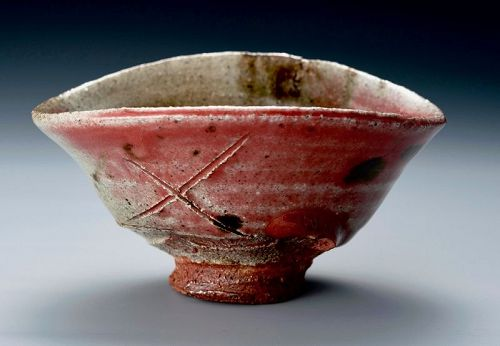
He originally learned his ceramics at high school then in 1962 entered the Tokoname Ceramic Art Institute and the following year won the principal award at the Asahi Ceramic Art Exhibition. He thought at the time that it was strange. “I did not expect it to be so easy“, yet he was already starting to become disillusioned with the way the Japanese ceramic world was structured and thus began his rebellious path. He set up his first studio and proceeded to make work in several genres from tableware in many styles – white works, hikidashi-guro(black), sometsuke (overglazed porcelain), yakishime and oribe through to trail-blazing sculptural expression like the singular series made, at different times, in tribute to Hiroshima and Nagasaki, Chernobyl and 9/11 where partial decomposition and disintegration was an element of the planned outcome from the firing part of the process. He deliberately did not court skill saying that what was more important was what else was present in the work. “The highly skilled I am sorry for – there is no meaning in just creating something. Those with only skill don’t convey feelings in their work.” His work could be provocative, boisterous and intense yet always with a sense of freedom and humanity, from his large installations to small sake cups.
One acknowledged huge influence was the revolutionary, 1950s Sodeisha artists in Kyoto, in particular Yagi and Yamada. Yet he also said “Everything is my teacher” and wrote that his influences included: “My mother, Yami’s death and my father. My grandparents’ stories of their travels. The Tomimoto family and music. Fishermen and sea, wind, sun. A slope, the shadow of an overpass. Pottery fragments, the remains of fires, spirits. I can’t write the names of drinking establishments – there is perhaps much one cannot write that has been a teacher or anti-teacher. Shitara’s water and cold wind. Various people. My first wife, Yoshiko.”
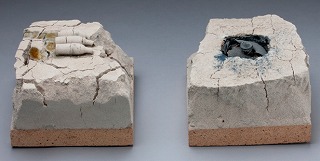
The Koie style made its major debut in 1968, at his first exhibition of that year, RETURN TO EARTH. Koie had been scheduled to show at an outdoor exhibition at the Modern Art Museum in Nagoya, but the event had to be cancelled due to political interference. Koie, beside himself with anger, showed up at the exhibition site anyway, and created a work there, alone. For this work, he took the powder of pulverized sanitation equipment (toilet bowls and basins) and formed a series of mounds, then placed on top of each an impression of his face, moulded by means of a mask, which was seen to gradually decompose, from mound to mound, until finally consumed in the final mounds.
This series shocked the art world but many came to see Koie as a great artist who questioned existing beliefs and one who made tremendous discoveries within the stuffy, tradition-bound Japanese ceramic art world of the time. His main questions back then were, “Who am I? What is living? What is dying?” And he answered “It’s how we live.”
He travelled to many countries exhibiting, giving demonstrations and talking about life and work – for him the two were inextricably mixed and his outgoing personality left an indelible impression wherever he went. His visit, as a guest artist to the first Gulgong Festival back in the 1990s was unforgettable for those who were there and they recall events with a wide smile. He returned to Tokonome to build a 20 metre long anagama kiln deliberately designed to fire very unevenly.
He won honours at the prestigious Vallauris Ceramics exhibition in 1972 and in 1980 was invited into the then influential International Academy of Ceramics. In 1992 he became Professor of the Aichi Prefecture University of Fine Arts and in 1993 he was gifted the esteemed, Japan Ceramic Society Award. His work can be found in major museums and galleries around the world from the Smithsonian in Washington to the V+A in London, the Metropolitan in NYC and the Museum of Victoria in Melbourne as well as every significant museum in Japan and Korea.
So when you observe and enjoy work that appears robust and spontaneous, or distorted as though still spinning, or with broken-bread textures and consciously gestural applications of lips, handles and lugs, or gritty, undomesticated surfaces and forms that have moved beyond utility, then think about one of the originators and certainly a master, Ryoji Koie.
This is absolutely worth visiting even if our own Covid drama is (hopefully) largely over. Particularly if you are teaching, it is a most useful resource. We have to remember that much of the rest of the world still has lockdown to some degree. Marty Gross, of the Mingei Film Archive, is conscious of this and in celebration of the 100th anniversary of the foundation of the Leach Pottery in Saint Ives, Cornwall he making available the film, “Working at the Leach Pottery, 1970” for viewing over the next 30 days.
This is how it was in 1970 but it would be not a lot different to how it was back in the late 50s/early 60s when Mirek Smisek, Peter Stichbury and Len Castle visited and worked there. Stichbury and Castle did not love their time there but Smisek enjoyed it and relished his good fortune at being there. Stichbury and Castle both left as soon as was possible, Stichbury to join Cardew in Abuja, (Nigeria) and Castle spent his time visiting museum collections of old pots wherever they could be found before returning to NZ. The last student there was reportedly Jeff Oestreich (USA) who was an apprentice there for two years until 1971. He would have been there when this film was made. Jeff first came to NZ in 1991 as recipient of a double Award of Merit from Ron Nagle as that year’s judge of the Fletcher Awards. Jeff liked it here and returned several times including a Residence at Unitec in 1995 and his visit to Napier on one of those visits left a permanent deco influence upon his work ever since. He has maintained contact via hosting NZ potters at his workshops in Minnesota- particularly for the famous St Croix River Pottery Traill event. His work can still be found in galleries and auctions here. The Leach Pottery has had a lasting influence upon New Zealand tableware production via artists like Oestreich and our own 50s pioneers and this evidences to this day.
Lockdown itch is still an issue. If your workshop is out in the back yard or somewhere equally handy and clay supplies are plentiful you’re probably carrying much on as usual. But for those who have studio space in some other location but want to stay with what we love so dearly – here are a few bits of entertainment that occupy mind and spirit if not the hands…
On screen is a great 10 part series called Blown Away. It’s another one of those competitive things where a lump of useful money is dangling at the end in response to participants jumping through hoops of various sorts. This one isn’t on clay but stay with me. It’s Canadian in origin and the format is the usual theme of a set of tasks or target and elimination of a participant each episode. Whether it’s cooking a mouthwatering dish, making domestic ware in clay or travelling from A to B by the most filmic route possible, its entertainment value lies in the personality of those fronting and judging and how engaging he, she or they can make things look and sound and also what comes through from the competitors by way of expressive commentary and character. Such factors often play a role in who eventually wins, or at least, if the competitor is good at it they often get to stay in for a longer time. This is TV after all. This programme around glass from an arts viewpoint meets these criteria better than most. It’s the level of articulation around the projects’ aims and objectives and the ability of the competitors to verbalise what and why they are doing that lifts this programme well above anything similar. These are not beginner artists and those judging and commenting as guest interlocutors are fluent, lucid and effective communicators and it comes as no surprise to find most are teaching at tertiary level. The production values are very high with the magic translucence of glass allowed to be at centre stage with ample great shots of fiery furnaces, sweaty brows, steam swirling and molten glass twisting on the end of a punty to add drama. NETFLIX
Then there is The Great Pottery Throwdown and Keith Brymer-Jones has returned for a third season. Replacing the other potter is ceramic designer Sue Pryke and again the competition sets a series of challenges thus eliminating one of the competitive twelve ‘home potters’ in each episode. Interestingly, Brymer-Jones will recreate the programme format with a daily competition at the next Gulgong Ceramics Festival where he has been a regular guest for the past two events. See it on your screens in BBC FOUR.
Brymer-Jones is now a co-host, with two others, on another BBC programme. The Victorian House of Arts and Crafts is about seeing what it might be like as a craftsperson back in the late 1800s where things were a shirt, collar and tie for men and whalebone corsets for women They inhabit an Arts and Crafts house in Wales and re-make period crafted items – maybe Brymer-Jones has to copy something from the Martin Brothers or something Bloomsbury. BBC TWO
Also on the BBC is Handmade where the making of craft objects is carefully followed and focus is on process. It has been described as ‘mesmerising’. BBC FOUR
Then on BBC again, this time Channel Five is (reality programme)The Wonderful World of Crafts where amateur enthusiasts attempt to turn a fascinating hobby into a business with the aid of an established crafter. Might be useful.
Finally , one of the world’s greatest repositories of objects, the Victoria and Albert Museum in London, has a six-part series showing behind the scenes activities of staff from curators to apprentice restorers – exhibiting the care and love they lavish upon their objects.
If viewing is off the ticket because your hands are busy then podcasts are the answer to more of the riveting stuff on Covid 19. Next time you are making as many egg cups as will fill all those tiny spaces in the kiln plug in your phone and try for podcasts, MaterialMatters, The Modern Maker, or maybe The Minimalists or, one I have been listening to for many years, 99% Invisible which started back in 2013, I think, with six or ten minutes and now offers at least once a week (as part of the American Radiotopia network) 30 to 40 minutes or so on a wide-ranging list of subject material under the umbrellas of Architecture and Design. Hosted by Roman Mars these narratives have been my bedtime stories for many years now and while clay rarely enters the scene the variety of engaging topics can cover anything from ‘Wipe Out’ – a very current issue tracing the history of toilet paper, to a philosophical rave with Frank Gehry to a rationale around Isamu Noguchi’s multi-media sculpture that he called ‘Play Mountain’. Always great listening.
As we are all unable to carry out normal (whatever that may mean) duties during this time, here is a wonderful film of what it was like producing pots – many of them, in Mashiko Village, Japan, back in 1937. You see not only individual skills but the collective efforts with clay refining and firing necessary for all the potteries in the village to survive. Particularly you see the pivotal parts played by women and the damn hard work involved!
Originally schedule to be shown at Gulgong, this film is now made available courtesy of Marty Gross, Producer and Director of The Mingei Film Archive who, over the past 35+ years has collected films documenting the origins and manifestations of the Mingei (Folk Craft) Movement in Japan and Korea (among other things). Marty’s collection includes early independent films and significant unseen footage. These are restored, digitised and enhanced with new commentaries so that their precious content might be remembered and appreciated today.
For more information I suggest you can go to the Archive website which will demonstrate not only the range of films Marty has collected and restored (including Bernard Leach’s visit to New Zealand in 1962 and films made by Bernard Leach himself while re-visiting Japan in 1934) but you can view ‘before and after’ imagery that illustrates the superb differences made by the restoration processes. It has been an enormous, painstaking and still on-going project for the Archive but one that has support by many major organisations such as: Japan’s National Film Archive, the Folk Crafts Museum and the Japan Foundation, the Leach Pottery, the Crafts Studies Centre in the UK, the Korea Film Archive, the Korean Ceramic Association plus the Museum of Modern Art and Contemporary Art of Korea to name but some.
The film on Mashiko, that takes a little over half an hour will be available for 30 days.
https://vimeo.com/377634011
Sales and downloads of the films are not possible at this time but to request a list of all films in the Mingei Film Archive, please contact: films@martygrossfilms.com
Thanks are due to… Furuya@mingeikan.or.jp chitose.sato@qpr-tokyo.com marty@martygrossfilms.com peter@martygrossfilms.com pmundinger@bell.net
The inaugural exhibition of the Leach 100 centenary celebrations, ‘Leach Studio Potters: 100 Years On’ celebrates the rich creative talents of the potters who produce the iconic Leach Standard Ware.
Various celebrations will, it seems, continue all this year. So, if in Cornwall, go see…
January 27th 2020. Robert died this morning, losing his battle with pancreatic cancer. He was in Te Omanga Hospice in Lower Hutt where he had been for a while, happy to be there and family were present including a sister from Vancouver in Canada.
I first met Robert when, in 1997, as the newly appointed Curator for The Dowse Art Museum I spent my first weekend in Wellington wandering around downtown trying to orient myself. Along a wide dusty street there, in a furniture shop window, I spotted a cluster of ceramic ships, large and small, loosely modelled in earthenware and slip painted with a clear glossy glaze on top. I had never seen anything quite like them as they sailed wildly across a maroon carpet around some oak chairs, a coffee table and a sideboard seemingly extracted from the 1940s. Surprised, intrigued and wanting some close-ups I tried the door but the shop was closed.
Monday morning I reported my titillating find to some of the Dowse staff who were not at all riveted and told me the maker had to be Robert Rapson and “simply everyone has one of his ships in their collection”. I learned he had never exhibited at any gallery in Wellington and simply sold through that furniture and framing shop, who were friends of his. I had to accept, in my Auckland ignorance that this was how he wanted things. Later, once I got to know him a little he told me that he had always wanted to be an artist from childhood but was deterred by an adult’s remark that there was “no money in it” so he did a B.A. at Victoria instead and became a civil servant. He learned to make in clay as a sort of therapy when he was a client at Vincent’s – a Wellington public arts facility. He told me then he was clinically depressed sometimes and also had Asperger’s syndrome which kicked in in the 80s after Rogernomics scythed through his workplace and his job disappeared along with the rest of the Government Department he worked in.
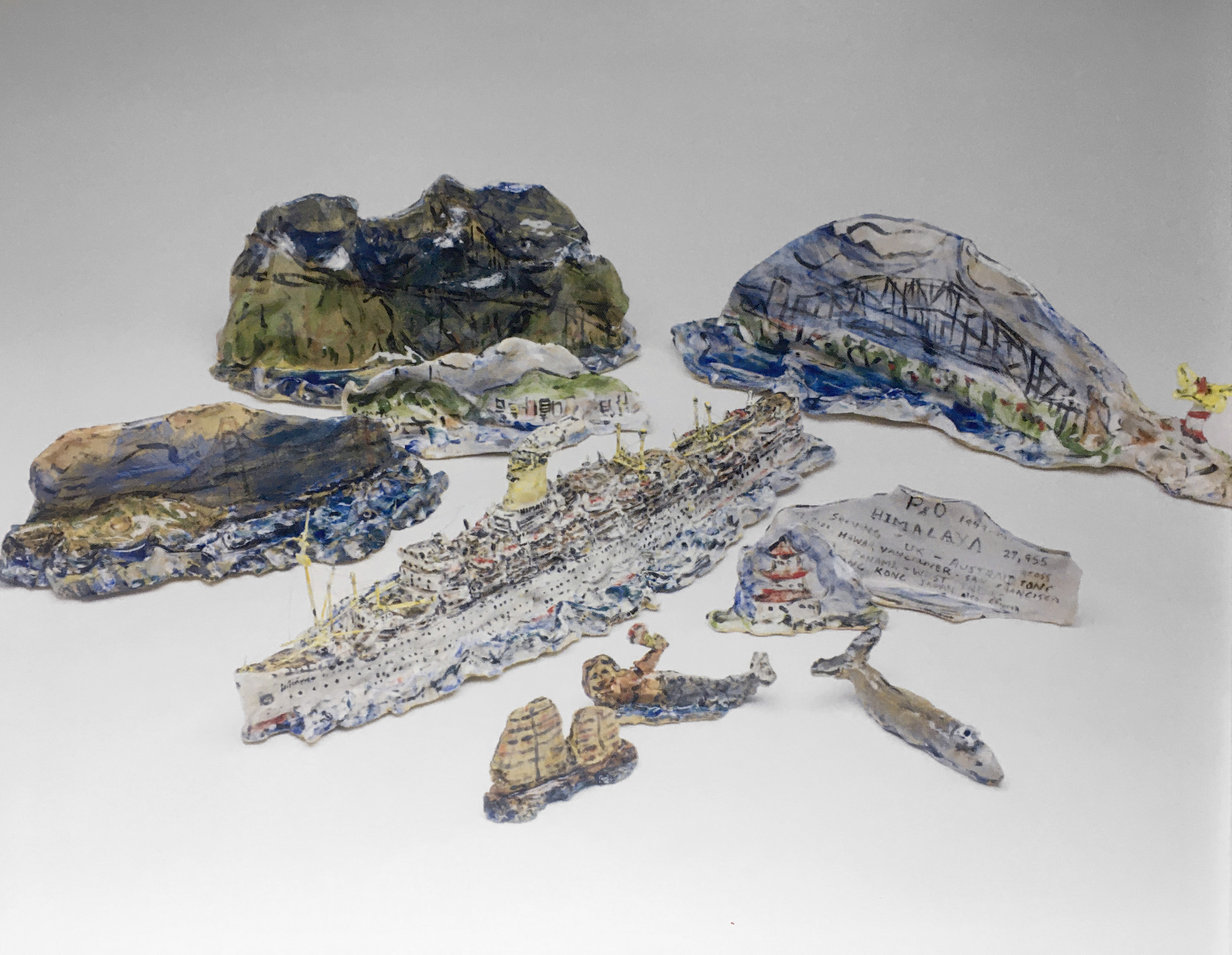
His health issues came and went over the intervening years but his enjoyment working with clay never wavered. And it was ships that were his enduring passion – not just any old ship but huge ocean-going steamers of the mid-20th Century were central. Luxury vessels taking lengthy, romantic and expensive cruises such as the great Cunard liner the Queen Mary or the Italian Angelino Lauro – on which he made his first sea journey at age 20. You could name any such vessel and you’d find he had files containing details such as where built, how fuelled, passengers carried, numbers of decks, cabins, lifeboats and funnels. I once told him the name of the ship by which my family emigrated to Australia from England. On my return to Auckland the next day I found an envelope with copies of that ship’s details, an image, records of its history as a troop carrier in WWII and the later numbers of immigrants it carried and where they boarded, and finally its demise on a Bangladeshi wrecker’s foreshore. He had further files on our NZ coastal shipping – the smaller vessels – steamers, tugs, and ferries that chugged up and down the coast with goods, animals, and passengers of every sort. He was fascinated with almost anything that floated, particularly if it sailed NZ waters in some capacity as his father had been a wharf worker. He spent much time executing commissions for clients who had memories of particular ships and while made in his loose, spontaneous, yet direct and expressive style were nevertheless, always very precise in detail – physically and formally but also usually recorded beneath the work in tiny script.
‘RMS ORIANA visits Auckland and Wellington‘. Portage Awards 2006. Photo: Howard Williams.
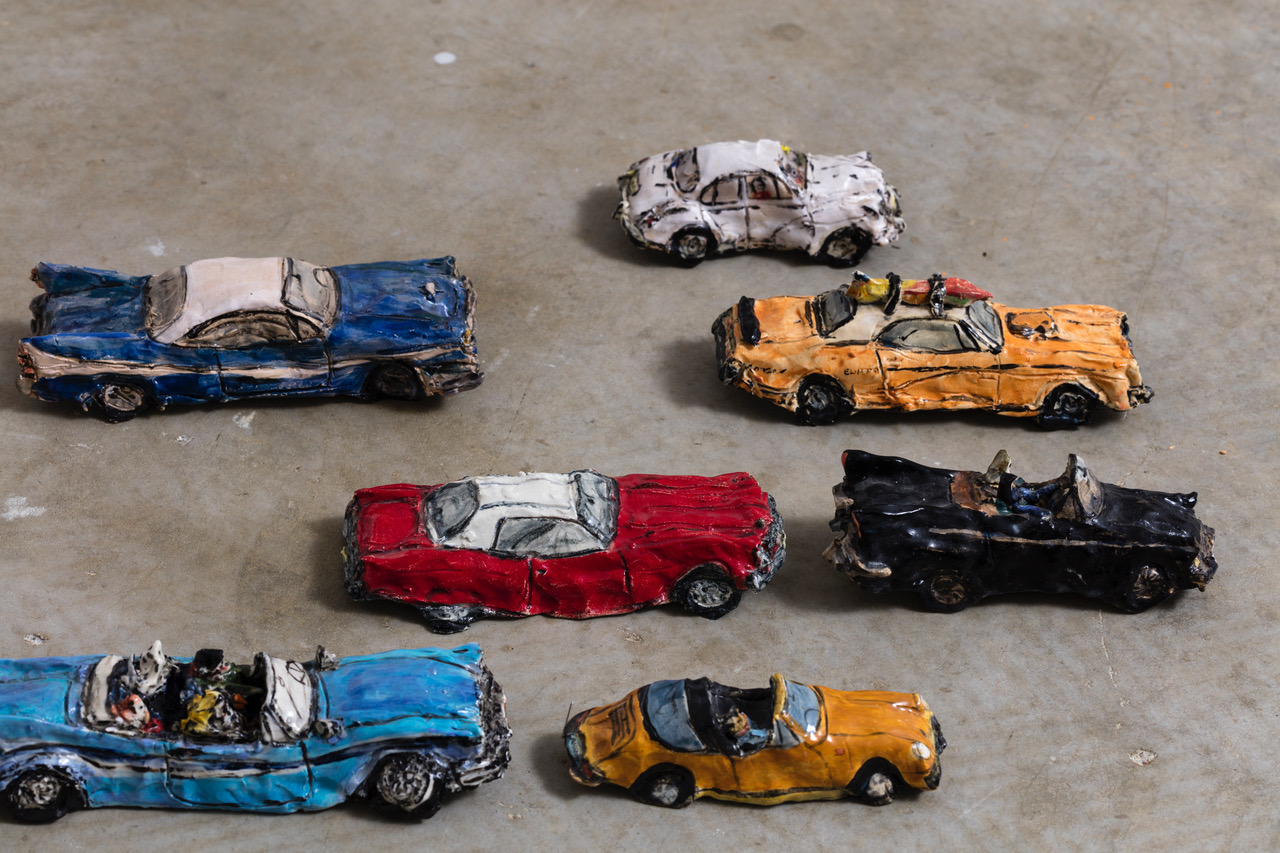
He invested into broadening his subject matter by producing cars and airplanes sometimes, as well as making additional pieces to embellish the environments around his ships – whales and sharks, mermaids, buoys, small yachts, windsurfers or lighthouses and edges of landscapes as well as recognisable icons which might point to where this particular ship was sailing under or around such as distinctive bridges, Opera Houses or white cliffs.
He had many successes for his work over his more than 40 years of practice. He was invited to be resident artist at Otago School of Art Ceramics Department in Dunedin and he won the Molly Morpeth Canaday prize in Whakatane when it was (possibly last) designated for ceramics. When Robert won a second prize at the Norsewear Art Awards in Hawkes Bay, Premier Award winner, Jim Cooper said, ” It’s not about polish or sophistication, it’s felt, it’s got heart and I think that’s bloody spiritual. That’s what I like about Robert’s work.” Most notably he won the Premier Award in the Portage Ceramics Awards when Canadian, Amy Gogarty, writer, painter and historian, was judge. She commented on the “quality of his painted surface”. She observed that he, “combines efficient drawing, delicious scumbles and keenly observed detail with beautifully modelled plastic form. He reconfigures vivid childhood memories with imagination and wit, creating a vivid tableau that invites engagement” She continued that his work ‘taps into collective fantasies of far-off places and celebratory events” … and that “he deserves my highest recognition and respect.’
‘Himalaya serves the World, 1949 – early ’70s’ Premier Award in Portage Awards 2013. Photo by Sean Shadbolt.
Robert celebrated this $15,000 win by taking a three month round the world trip and on return was rewarded with yet another prize, the Arts Access Artistic Achievement Award which recognises the ‘outstanding achievement and contribution of an artist with a disability, sensory impairment or lived experience of mental illness’. For this, he received a trophy that he had made himself as he had carried out the commission for the award for the previous four years. He was included in an exhibition of ‘Outsider’s Art’ that was shown in New York. His work sold out and he received fifteen commissions for new (ship) works. Another ‘Outsider Art from NZ” exhibition took place in Paris and this too sold successfully for him. His work popped up in surprising places. I was with a couple of Australian friends in Los Angeles and as we walked along Third Street following a visit to LACMA, we spotted some very large pots in a small shop window. The ‘small shop’ turned out to be a very hip ceramics gallery called South Willard. On entering I strolled up the long narrow space and was stopped in my tracks by a display shelf of oddly familiar ships and had an animated exchange with the owner when I asked him how on earth he had Robert Rapson’s ceramics there. On another visit to Los Angeles last year I met a ceramist (Stan) who had helped Robert on a residency there making work for another show at the same gallery (see July 5th post in this blog). So just a year or so ago Robert was in the USA, working. His illness appears to have been not too protracted.
He was happiest working around people. He remarked one time that on inheriting his mother’s former house he tried to “go it alone and failed miserably”. He joined Mix – a creative space that provides artistic opportunities for people with lived experience of mental illness, and the Hutt Art Society, and enjoyed having people around while working on his ships. “I have a community – somewhere to go and social contact. It’s much more interesting and helps my head.” He lived alone (with his cats) but was far from solitary and was a friend to many. He will be missed.
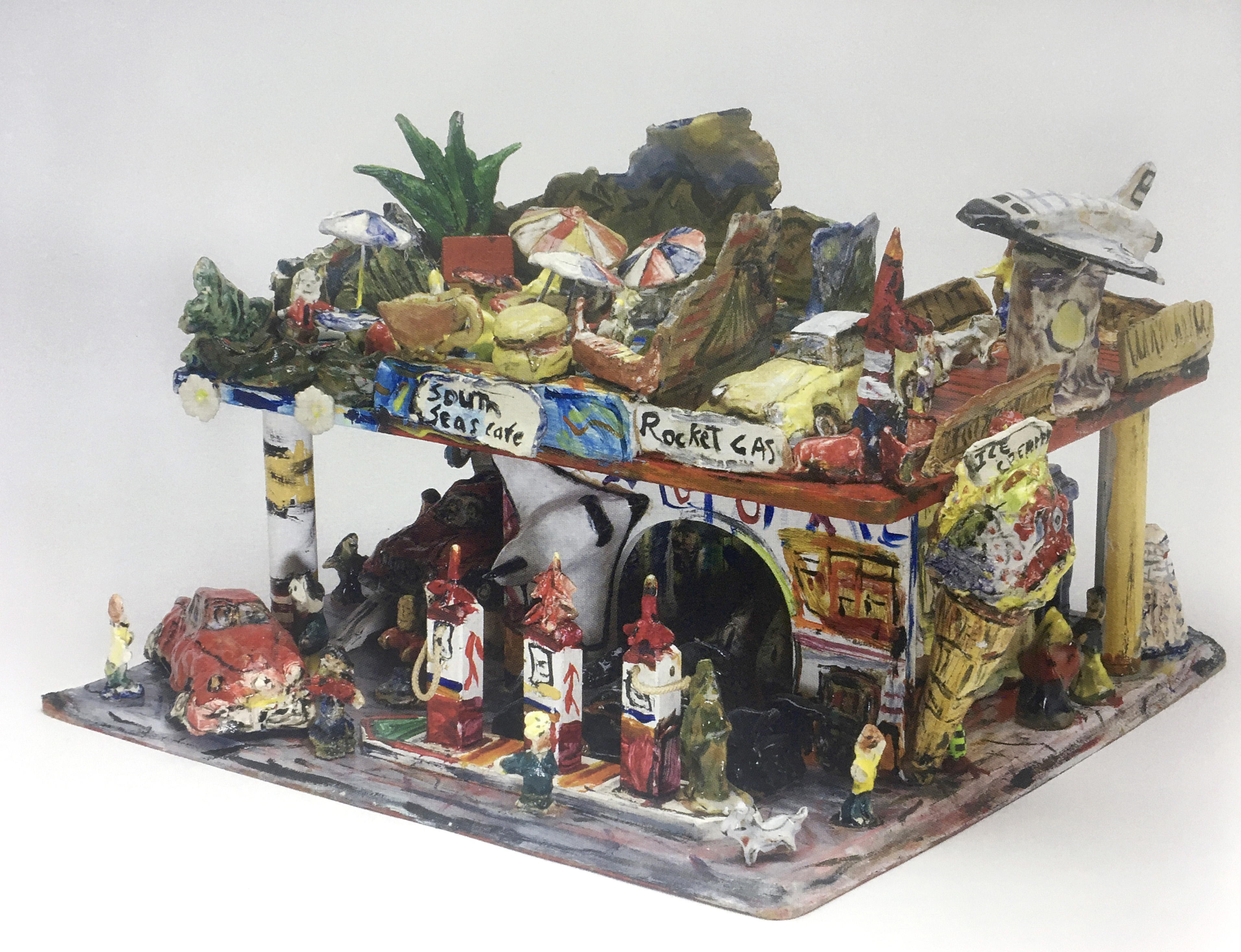
‘Rocket Gas Service Station and Centre’, Portage Award exhibition, 2015. Photo, Haru Sameshima.
‘Cars’. Collection R. Fahey. Photo: Sam Hartnet.
P.S. A Gathering to Celebrate the Life and Art iof Robert Rapson will take place at Hutt Art Society 9-11 Myrtle St, Lower Hutt next Wednesday Feb 5 from 10-30am.
If attending, please send notification to Katherinewgtnsmyth@gmail.com so that space, chairs, food, etc can be catered for….
The ceramic community has not been spared and a number of rurally based potters have lost a lot or even everything. To help a re-start, Owen Rye is collecting equipment and tools that are no longer required and he will distribute. He will be at Clay Gulgong in April this year and so will the NZ contingent – this time Richard Stratton, Andrea du Chatenier and me – all with various tasks to perform while there. I would be happy to take across tools and anything else you might no longer need- providing I can carry it and will pass anything donated on to Owen. Andrea and Richard will be carrying their works for exhibition over there so probably would have trouble with extra weight but they do not need me to carry things for them this time so if you’d like to contribute, please be in touch so we can sort out how I can collect.
If you’d like to donate money please send to Wildlife Victoria Bushfire Appeal or www.WIVES.org.au (NSW animals) or Red Cross Disaster Relief and Recovery. But practical tools for potters please get them to me. moyraelliott@gmailcom


_Photo+by+Andrew+Scrivani.jpg?fit=crop&ar=1:1&auto=compress&cs=srgb)
+%2B+tart+made+from+everything+a+pig+eats_Photo+by+Andrew+Scrivani.jpg?fit=crop&ar=1:1&auto=compress&cs=srgb)
_Courtesy+of+Gregg+Moore.jpg?fit=crop&ar=1:1&auto=compress&cs=srgb)
+Plate_Photo+by+Andrew+Scrivani.jpg?fit=crop&ar=1:1&crop=focalpoint&fp-z=1.3&auto=compress&cs=srgb)





 Cone Ten and descending...